
WRAHP Concludes Validation Meetings in Five Edo Communities, pledge to Address Gaps Between State , Traditional Laws, Women Financial management
By Mercy Onyenweli
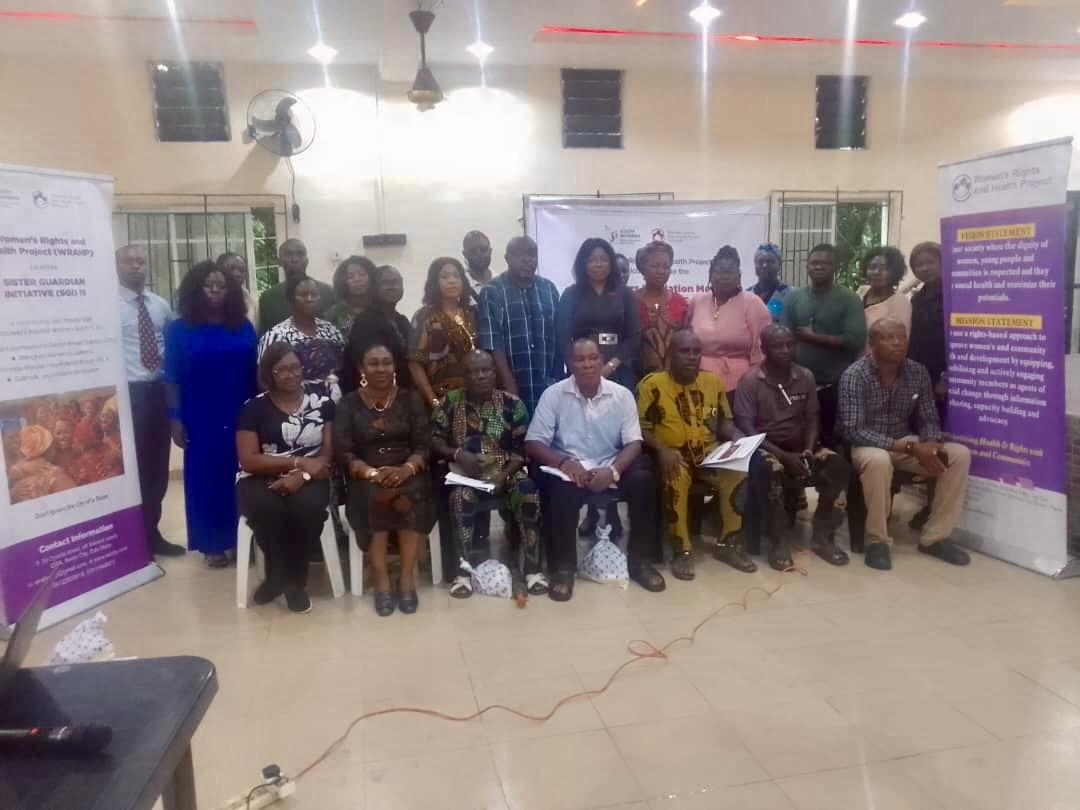
The Women’s Rights and Health Project (WRAHP), with support from the South Saharan Social Development Organisation (SSDO), has concluded a five-day community-level validation exercise across five communities in Ikpoba-Okha Local Government Area of Edo State. The exercise reaffirmed the organisation’s commitment to addressing conflicts between state laws and traditional practices while equipping women with financial management skills.
The validation meetings, which was held from August 24 to 28, 2026, were organised under the 15-month Sister Guardian Initiative, an intervention designed to address gender-based violence (GBV), harmful cultural practices and barriers affecting women and girls at the community level.
The meetings took place in Avbiama, Evboligun, Obah, Umelu and Iriwhin community respectively had in attendance residents, traditional leaders, women, young people and other stakeholders reviewed and validated the findings from a baseline assessment previously conducted through Focus Group Discussions (FGDs).
Speaking to newsmen at the end of the exercise, WRAHP Executive Director, Mrs. Bose Ironsi, described the validation process as a co-creation exercise aimed at ensuring that community members actively participate in identifying challenges affecting women and developing solutions.
According to her, the exercise was insightful, as participants from the different communities expressed varying perspectives on culture, women’s rights and the need for change.
“It is a co-creation. We are going to meet with the women and ask them, what do we do? It has been very revealing and interesting. In some communities, they want change, while in some they are holding back. We are still going to come back and look at those issues and address them.”
Mrs. Ironsi noted that one of the major findings across the communities was the limited awareness of laws protecting the rights of women and children, including legislation relating to widowhood practices and female genital mutilation.
She said WRAHP would continue engaging the communities to educate residents about existing laws and examine areas where traditional practices conflict with state legislation.
“We are going to meet with them again and draw their attention to these laws and their traditional laws that conflict with the state law, and see how they come up with bylaws they can pass down from generation to generation,” she said.
The WRAHP Executive Director also identified women’s economic empowerment as a critical component of restoring women’s voices and participation in community decision-making.
She explained that the organisation would support women with financial management and savings skills to enable them to manage their resources effectively and strengthen their economic independence for leadership positions.
“For the women, we have understood that what made them lose their voices is because they are not empowered. So, we are going to take them through the saving process so that they know how to save their resources rather than consuming everything,” she said.
Mrs. Ironsi further explained that the validation process enabled the organisation to compare the experiences of different age groups. She noted that younger participants appeared more willing to challenge certain cultural practices, while older participants were more inclined to preserve them.
“The older ones are holding back to culture, the younger ones are saying we need to do away with this culture. The middle age are neither here nor there,” she said.
She stressed that the ultimate objective was not merely to document the challenges but to ensure that identified solutions were implemented.
“My message to them is that the change they want is doable. They have to be determined to see it come,” she added.
Speaking earlier, the WRAHP Consultant , Pastor Blessing Eromon explained that the baseline assessment was designed to provide deeper insight into the experiences of Women in the community and the social and cultural factors influencing GBV and harmful practices.
According to her, the validation meetings enabled stakeholders to confirm whether the findings accurately represented their lived experiences, clarify areas requiring further explanation and contribute additional perspectives.
On her part , the Benin project officer, Cheritta Joy Awaikhu said that the ultimate goal of the Sister Guardian Initiative was to contribute to safer and more equitable communities where women, girls and other vulnerable groups could live with dignity, exercise their rights and realise their full potential
She stressed that communities should not be treated merely as sources of data, stressing that their experiences and voices are essential to understanding the issues and co-creating sustainable solutions.
She emphasized that the organization would continue to engage communities and relevant stakeholders to strengthen community ownership, promote awareness of women and children’s rights, improve women’s economic empowerment and develop locally driven solutions to GBV and harmful cultural practices.
Speaking to some of the participants at Iriwhin community, the Okaighele, Benson Ogbebor Isibor, said the community was not opposed to women occupying leadership positions but stressed the importance of education and capacity building.
He said women who were adequately trained and educated should be given opportunities to participate in leadership.
“It is not that we don’t want to give women the opportunity to hold leadership positions. It depends on how educated they are. I have seen many women who thrive in leadership positions. If our women are trained, we will give them the opportunity to hold positions,” he said.
He also called on the government to support initiatives that promote the education and development of women.
Another participant, Joy Morose, commended WRAHP for bringing the Sister Guardian Initiative to the community and expressed optimism that the programme would contribute to positive change.
She said the initiative was a welcome development that would help women understand the importance of empowerment and become better equipped to improve their lives.
.