

Wike’s Edo Election Revelations Signal How Godfathers Are Turning Nigeria’s Democracy into a Private Arrangement
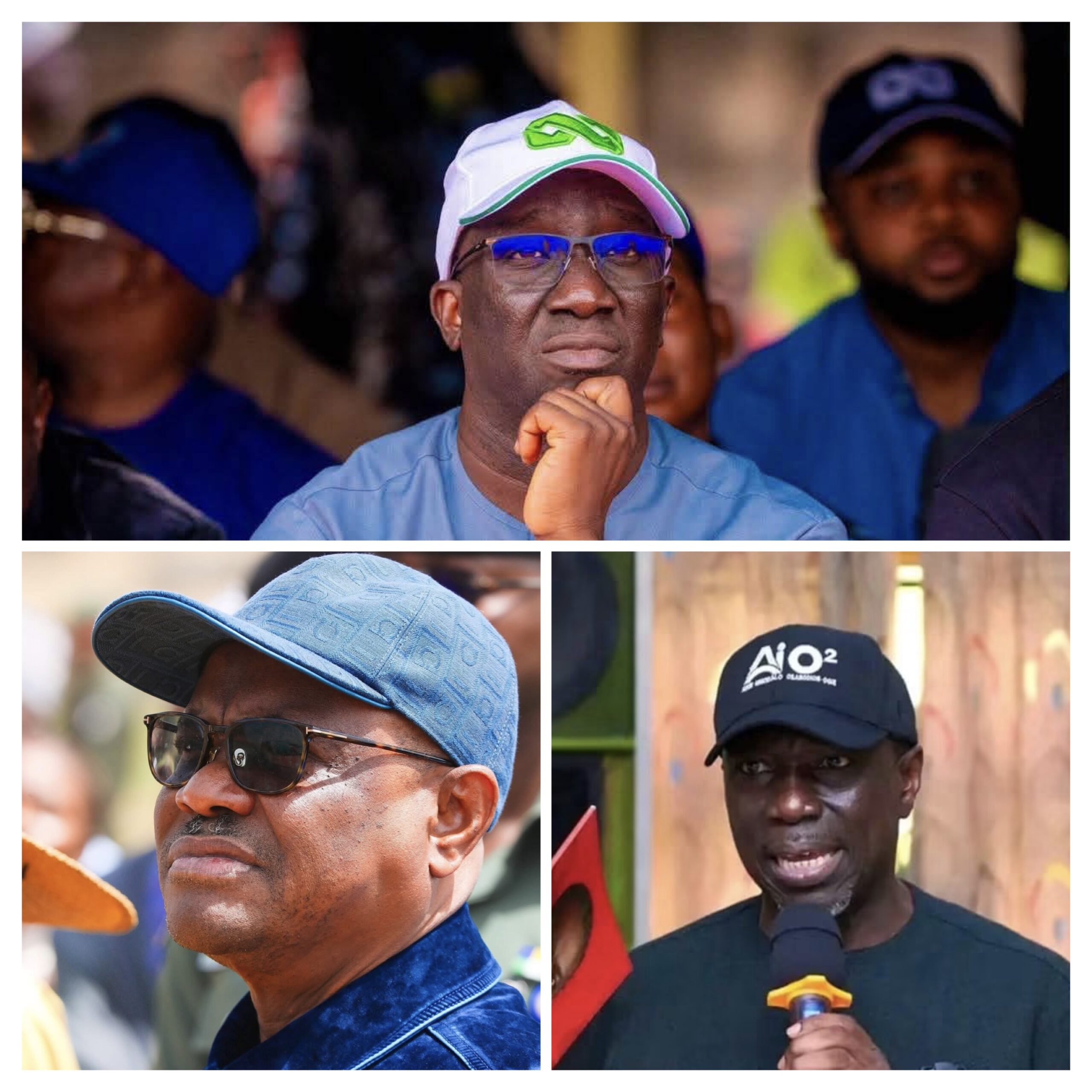
By Paul Omo Okojie
Nigeria’s democracy faces another uncomfortable moment following the startling admission by the Minister of the Federal Capital Territory, Nyesom Wike, that he worked behind the scenes with political forces in the All Progressives Congress (APC) to ensure that the Peoples Democratic Party (PDP) and its candidate, Asue Ighodalo, lost the September 21, 2024, governorship election in Edo State.
Wike’s remarks, reported on October 13, 2026, are significant not merely because he acknowledged working against his own party’s candidate, but because of the reason he gave for doing so. According to reports of his address at a political stakeholders’ meeting in Abuja, he said: “I was behind it, and I don’t have any regrets about it.” He also stated that the victory of Governor Monday Okpebholo was the product of a coalition between elements of the PDP and the APC.
The minister’s statement raises a fundamental question about the character of Nigerian democracy: when influential politicians decide who should win or lose an election based on personal grievances and political calculations, what becomes of the millions of citizens who queue under the sun and rain to cast their votes?
Wike reportedly explained that his opposition to Ighodalo was rooted in his determination to prevent former Edo State Governor Godwin Obaseki from choosing his successor and retaining political influence through the new administration.
In explaining his position, Wike said that Ighodalo was a good candidate but that he was unwilling to support him because of his association with Obaseki. This shows how the ruling elite don’t want the progress of the state and they take political vengeance to the detriment of the people.
According to the reported remarks, Wike said: “You’re a good candidate, but for this election, I’m sorry.” He further explained that he considered Ighodalo’s victory equivalent to allowing Obaseki to return to power through another person.
This is where the democratic implications become troubling. A candidate may be qualified, experienced and capable of governing, yet become unacceptable to powerful political actors because of the identity or political interests of the person who supports him.
Democracy is supposed to give voters the power to assess candidates based on their records, manifestos, competence and character. It should not become a contest in which political godfathers determine which candidates must succeed or fail to settle personal scores.
Wike’s account, therefore, presents a disturbing picture of how political alliances can be organised around the exclusion of a rival rather than a competition of ideas and public policies. This also show that Okpebholo was backed all through is court cases down to the Supreme Court.
However, the most consequential aspect of Wike’s admission is his acknowledgement that political actors from different parties worked together to defeat the PDP candidate. This is how Nigerians are being treated when they have a chance to close a better leader who would lead them.
Although Wike remains associated with the PDP, he has maintained a close political relationship with the APC-led federal government. His latest remarks suggest that this political alignment extended into the Edo governorship contest, where he said elements of the two parties worked together against Ighodalo.
The minister reportedly insisted that the coalition was real and challenged those denying its existence to acknowledge the arrangement. He also named Governor Okpebholo and Senator Adams Oshiomhole as people who could attest to the role the coalition played in the election.
Political coalitions are not inherently undemocratic. In a constitutional democracy, politicians and parties are free to negotiate alliances, endorse candidates and persuade voters to support their preferred choices.
The problem arises when political cooperation is driven by the determination to frustrate voters’ preferences, undermine a party’s own candidate or use influence over political structures to predetermine electoral outcomes.
Wike’s comments do not, by themselves, establish that votes were falsified or that electoral officials unlawfully altered results. They do, however, expose the extent to which elite political calculations can influence the environment in which elections are contested.
The question Nigerians must ask is whether political alliances are being used to broaden democratic participation or to concentrate power in the hands of a small circle of influential individuals.
This bring about the hard question we all must answer. Did the people choose, or did the political establishment decide?
The Independent National Electoral Commission (INEC) declared Monday Okpebholo of the APC the winner of the Edo governorship election with 291,667 votes. Asue Ighodalo of the PDP was credited with 247,274 votes, while Olumide Akpata of the Labour Party received 22,763 votes. Okpebholo won with 44,393 vote to become Governor.
Those are the officially announced results. But the political circumstances surrounding an election are also important to understanding the health of a democracy.
If powerful politicians can openly acknowledge that they mobilised political alliances to ensure that a particular candidate failed, Nigerians are entitled to demand greater transparency about the nature of those arrangements and their implications for electoral competition.
Did the coalition simply persuade voters to support Okpebholo? Was it limited to political endorsements and mobilisation? Or did it involve other forms of influence over party structures, campaign resources or the electoral environment? These are legitimate questions, but they require evidence before any conclusion can be reached.
An election must be judged not only by the announcement of a winner but also by whether citizens had a genuine opportunity to make a free and informed choice without intimidation, manipulation or the improper use of state institutions.
The danger is that repeated admissions of behind-the-scenes political engineering may deepen public suspicion that elections are increasingly decided by negotiations among powerful interests rather than by citizens alone.
Due to this troubling precedent for Nigeria’s electoral future. Wike’s comments should also be seriously examined against the broader problem of political loyalty in Nigeria. Politicians frequently change alliances, abandon party positions and support opponents when doing so advances their interests. Such conduct may be legal in particular circumstances, but it can undermine public confidence when personal relationships and political vendettas appear more important than party principles and public accountability.
A democracy cannot thrive when political parties become temporary vehicles for individual ambitions rather than institutions organised around clear policies and programmes.
If a minister can publicly acknowledge working against his party’s candidate because he wants to prevent a former governor from installing a successor, what assurances do voters have that similar calculations will not shape future contests elsewhere in the country?
The danger extends beyond Edo State. Nigeria is approaching another major electoral cycle, and the 2027 general election will test whether political parties can offer credible choices or whether alliances among influential politicians will increasingly determine the limits of electoral competition.
The lesson is not that politicians should be prohibited from forming coalitions. It is that those coalitions must remain subject to democratic scrutiny, electoral laws and the sovereignty of the electorate. These acts must be checkmated by political parties before it gets out of hand.
INEC and the credibility question: INEC must take seriously the public concerns raised by admissions of political coordination around electoral outcomes. The commission should consistently ensure that party agents have meaningful access to collation, that results are transparently documented, that complaints are investigated and that credible evidence of irregularities is addressed.
It is equally important to distinguish political influence from electoral malpractice. Wike’s account is an admission of political coordination, not conclusive proof that INEC manipulated the Edo results or that Okpebholo’s declared votes were unlawfully manufactured. But it raises a clear concern for a likely possible manipulation of election results.
Indeed, the Edo election result was subsequently upheld by the courts, including the Court of Appeal. That judicial outcome is an important part of the record, even as citizens retain the right to debate the broader political culture in which elections take place.
The commission should not be condemned without evidence, but neither should the country dismiss troubling political statements simply because a winner has been officially declared or a legal challenge has failed.
Electoral credibility depends on verifiable processes, public trust and accountability. Where politicians make claims about the forces behind an election outcome, the public deserves facts rather than speculation or partisan counterattacks.
Its time for the electorates to be determined and reclaim its democracy. Ultimately, the greatest danger revealed by Wike’s remarks is the possibility that Nigerian voters are being reduced to spectators in a political game whose rules are written by powerful insiders.
When politicians regard elections as opportunities to punish rivals, reward allies and control succession, public policy becomes secondary. Citizens who need employment, affordable healthcare, reliable infrastructure, security and economic opportunity are left with political drama instead of accountable leadership.
Edo voters, like citizens in every Nigerian state, deserve to know that their votes count, their choices matter and their future is not being negotiated in private meetings among political heavyweights.
Wike is entitled to explain his political decisions. But his own account has created an opportunity for a wider national conversation about whether Nigeria’s political parties are protecting democratic competition or facilitating the concentration of political power.
The appropriate response is neither to declare the election stolen solely on the strength of his remarks nor to wave away their implications. It is to demand transparency, investigate credible allegations of electoral misconduct and strengthen safeguards that prevent political influence from becoming electoral control.
Nigeria’s democracy cannot be secured by election-day voting alone. It requires institutions capable of protecting the voter against manipulation, parties that respect the electorate and political leaders who understand that public office is not a private instrument for settling scores. Public office is service to the people and disservice to the nation.
The ultimate question is simple: if political leaders can openly boast about the alliances they used to ensure that a candidate failed, will Nigeria’s next generation of elections be decided by the people’s votes, or by the calculations of those who believe they own the political process?
That is the question Wike’s admission has placed before the nation, and it deserves a serious answer.