

NAF 931 Crash: Beyond the Mourning, Nigeria Must Ask the Hard Questions
By Davidson Ogbebor
The Nigerian Air Force ATR-42 crash at Igbokoda, Ondo State, has become more than another tragic entry in Nigeria’s long history of aviation disasters. It is now a test of whether the country can confront uncomfortable questions about military aviation without allowing grief, institutional secrecy or premature conclusions to bury them.
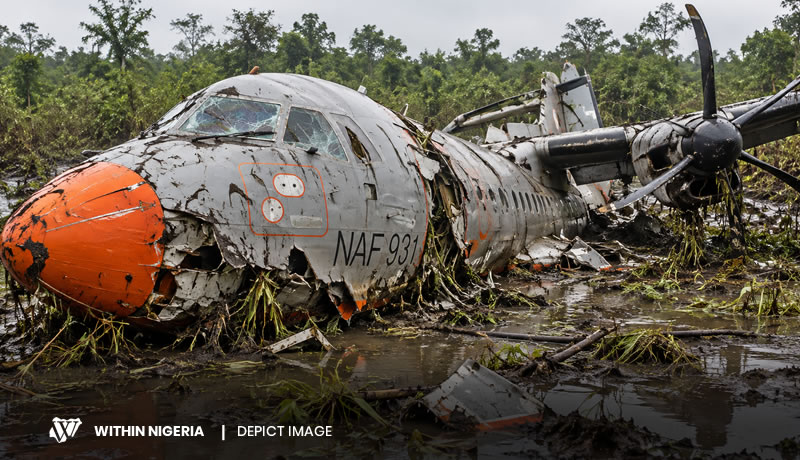
The aircraft, identified as NAF 931, was travelling from Benin City, Edo State, to Lagos on what the Nigerian Air Force described as a routine mission when it crashed near the Naval Base at Igbokoda in Ilaje Local Government Area on Monday, October 5, 2026.
The latest official account from the Nigerian Air Force states that 25 people, five crew members and 20 passengers, were aboard and that there were no survivors.
President Bola Ahmed Tinubu has declared three days of national mourning and ordered a thorough investigation into the accident. The Defence Headquarters has also confirmed that an investigation will be conducted to establish what caused the crash. (State House Abuja)
That investigation must go beyond producing a report. It must produce answers. The first question: What brought NAF 931 down?
At this stage, nobody outside the investigation can responsibly say that mechanical failure, pilot error, adverse weather, maintenance problems or any other factor caused the accident.
The aircraft disappeared from communication and radar during its journey from Benin to Lagos before the wreckage was located around Igbokoda. That sequence demands a forensic reconstruction of the flight.
Investigators should determine exactly what happened from the moment the aircraft departed Benin: its altitude, speed, engine performance, communications, weather conditions, flight path, last recorded position and any abnormal indications before contact was lost.
The cockpit voice recorder and flight-data systems, if fitted and recoverable, will be particularly important.
The public does not need speculation. It needs evidence. The maintenance history cannot be ignored Perhaps one of the most important issues now emerging is the maintenance history of NAF 931.
Investigative records reviewed by The ICIR indicate that the aircraft spent almost four years at Rheinland Air Service in Mönchengladbach, Germany, after arriving there in January 2021 for maintenance. Records reportedly show the aircraft still at the facility in September 2024 before returning to Nigeria in late December 2024.

That fact, if confirmed by the Nigerian Air Force, does not establish that maintenance failure caused the Ondo crash.
But it unquestionably makes the aircraft’s maintenance history relevant to the investigation.
Why did a military aircraft remain abroad for such an extended period? What major work was carried out? Which components were replaced or overhauled?
What work was certified before the aircraft returned to Nigeria?
How many flying hours did it accumulate after returning?
What inspections had been conducted immediately before the fatal flight? These are legitimate aviation-safety questions.
The answers should be contained in the investigation.
The aircraft was not an ordinary transport plane NAF 931 was an ATR-42-500MP configured for specialised military functions, including maritime surveillance and intelligence, surveillance and reconnaissance operations.
The Nigerian Air Force operated two such ATR-42 aircraft, NAF 930 and NAF 931. They were acquired from Italian aerospace manufacturer Alenia Aeronautica under a contract reportedly valued at $73 million, with the aircraft delivered around 2009 and 2010. (Premium Times Nigeria)
This makes the loss of NAF 931 significant beyond the immediate human tragedy.
Nigeria has lost an important specialised military capability.
The question is therefore not simply whether an aircraft crashed. It is whether the country has adequate systems to preserve, maintain and safely operate the specialised platforms on which national security increasingly depends.
A disturbing pattern deserves examination
The Ondo crash has also reopened the broader question of military aviation safety in Nigeria.
An analysis published by The ICIR found that at least 66 people have been killed in Nigerian military aircraft crashes since 2015, with several aircraft destroyed. The incidents have involved different aircraft types and circumstances, including combat operations, training, routine flights and maintenance-related activities.
This does not mean every crash has the same cause.
It does, however, raise a systemic question:
Is Nigeria doing enough to prevent avoidable military aviation accidents?
A country fighting insurgency, terrorism, banditry and other security threats cannot afford a military aviation system weakened by preventable accidents.
Every aircraft lost means money lost, capability lost and, most importantly, lives lost.
The ₦4.5 billion maintenance question
Political questions have already begun emerging around military aircraft maintenance funding.
The African Democratic Congress has called for an audit of funds reportedly released for NAF aircraft maintenance, citing ₦4.5 billion in maintenance-related funding. This is a political demand, not proof that any maintenance funds were mismanaged.
Nevertheless, the demand presents an opportunity for government to demonstrate transparency.
If substantial public resources have been appropriated for aircraft maintenance, Nigerians have a legitimate interest in knowing whether those funds were properly utilised.
Were maintenance contracts competitively awarded?
Were aircraft returned to service only after meeting prescribed technical standards?
Were independent inspections conducted?
Were spare parts genuine and properly certified?
Were maintenance schedules followed?
These questions should be answered through documentation rather than political argument.
Then there is the passenger-manifest discrepancy
Another issue that should not disappear from public attention is the conflicting passenger figures.
The Federal Ministry of Aviation initially announced that 25 passengers and seven crew members, or 32 people in total, were aboard the aircraft.
The Nigerian Air Force subsequently released a manifest showing 20 passengers and five crew members—25 people altogether.
The NAF’s figure should be regarded as the latest official account.
But the discrepancy still requires an explanation.
An aircraft manifest is not a trivial administrative document. It is fundamental to search and rescue, victim identification, family notification, forensic work and official casualty reporting.
The authorities should simply explain how the initial figure was produced and why it differed from the final manifest.
Transparency here would prevent unnecessary speculation. Don’t let national mourning replace investigation
President Tinubu’s declaration of three days of national mourning is an appropriate expression of respect for the fallen. But mourning must not become the conclusion of the national response.
The families deserve justice.The Nigerian Air Force deserves accurate answers. The public deserves accountability. And the country needs reforms capable of preventing another tragedy.
The investigation should therefore examine the aircraft’s complete technical history, maintenance records, flight hours, engine condition, recent inspections, crew qualifications and duty schedules, weather conditions, air-traffic communications, radar information, flight planning and the circumstances immediately preceding the loss of contact.
It should also determine whether there were any organisational or procedural failures.
The military must investigate itself, but transparency matters There is an inherent challenge when a military organisation investigates an accident involving its own aircraft.
Military aviation involves classified information, operational procedures and national-security considerations. Not every detail can therefore be released publicly.
But classification must not become a blanket justification for secrecy. The public can be given the cause of an accident without being given sensitive intelligence.
A final report can identify mechanical failure, human factors, maintenance deficiencies or operational shortcomings without compromising national security.
What Nigerians should not receive is a vague statement that an aircraft “developed technical difficulties” without an explanation of what those difficulties were and what is being done to prevent recurrence.
Igbokoda should become a turning point The loss of NAF 931 should force Nigeria to conduct a comprehensive review of military aviation safety. The review should consider: Aircraft maintenance: Are maintenance schedules being followed strictly?
Technical personnel: Does the NAF have sufficient numbers of highly trained engineers and technicians?
Spare parts: Are replacement components properly sourced and certified?
Aircraft utilisation: Are ageing aircraft being subjected to operational demands beyond their appropriate limits?
Flight safety: Are pilots and crew operating within rigorous fatigue and duty-time standards?
Emergency response: Can military aircraft in distress be located rapidly enough, particularly over Nigeria’s difficult terrain and waterways?
Tracking technology: Are military aircraft equipped with sufficiently reliable tracking and emergency-location systems?
Accident investigation: Are recommendations from previous military aviation accidents actually implemented?
These questions are not anti-military. They are pro-safety. Nigeria must learn from the deadThere is an unfortunate tendency in Nigeria for public attention to disappear after the funeral.
The dead are mourned. Condolences are issued. Flags are lowered. Families grieve. Then the country moves on. That cannot be the outcome of the Igbokoda tragedy.
If a technical problem contributed to the crash, it must be identified.
If maintenance contributed, it must be established.
If human factors contributed, the system must be examined.
If weather played a role, procedures must be reviewed.
If there was an organisational failure, responsibility must be addressed.
And if the accident was ultimately unavoidable, the investigation should establish that fact with evidence.
The objective should not be punishment for its own sake.
The objective should be prevention. The fallen deserve more than condolences
The 25 people aboard NAF 931 were military personnel, technical crew and passengers who departed Benin expecting to complete a journey to Lagos.
They never arrived. Their families will live with that loss long after the headlines disappear.
Nigeria therefore owes them something more enduring than condolences. It owes them the truth.
The Igbokoda crash must not become another unresolved tragedy in the history of Nigeria’s military aviation.
The country should mourn its fallen heroes, but it must also investigate without fear, publish what can responsibly be published, correct whatever weaknesses are discovered and ensure that lessons from NAF 931 become safeguards for the crews and passengers of every military aircraft that takes off from a Nigerian runway in the future.
The true measure of national mourning is not how loudly a country grieves its dead, but how seriously it acts to prevent others from joining them.