
Nigeria Needs a United Opposition, Not a Divided Alternative
By Paul Okojie
Democracy thrives on competition. It flourishes when those in government are subjected to rigorous scrutiny and constructive criticism by a credible and organised opposition that is ready not only to criticise but to govern. Sadly, that has largely been missing in Nigeria’s political landscape.
As the nation grapples with persistent economic hardship, rising unemployment, insecurity, hyper inflation and a widening infrastructure deficit, Nigerians deserve more than a fragmented opposition preoccupied with individual ambitions. They deserve a united political alternative with the vision, competence and courage to present a practical roadmap for national recovery.
The reality confronting millions of Nigerians is harsh. Families struggle daily with the rising cost of food and transportation. Businesses battle high energy costs and an unstable operating environment. Young graduates roam the streets in search of jobs that scarcely exist. Farmers are forced to abandon their lands in many communities because of insecurity, while investors remain cautious about committing capital to an economy burdened by uncertainty.
These challenges demand fresh thinking and bold leadership. They also require an opposition that understands that elections are won through unity, not division.
History has repeatedly shown that no ruling party willingly surrenders power to a fractured opposition. Political victories are built on coalition, compromise and shared purpose. Unfortunately, Nigeria’s opposition has often allowed personal ambitions, regional calculations and party rivalries to overshadow the national interest. The result has been predictable: divided votes, weakened campaigns and missed opportunities to provide effective democratic competition.
The time has come for opposition leaders to rise above politics of personality and embrace politics of purpose.
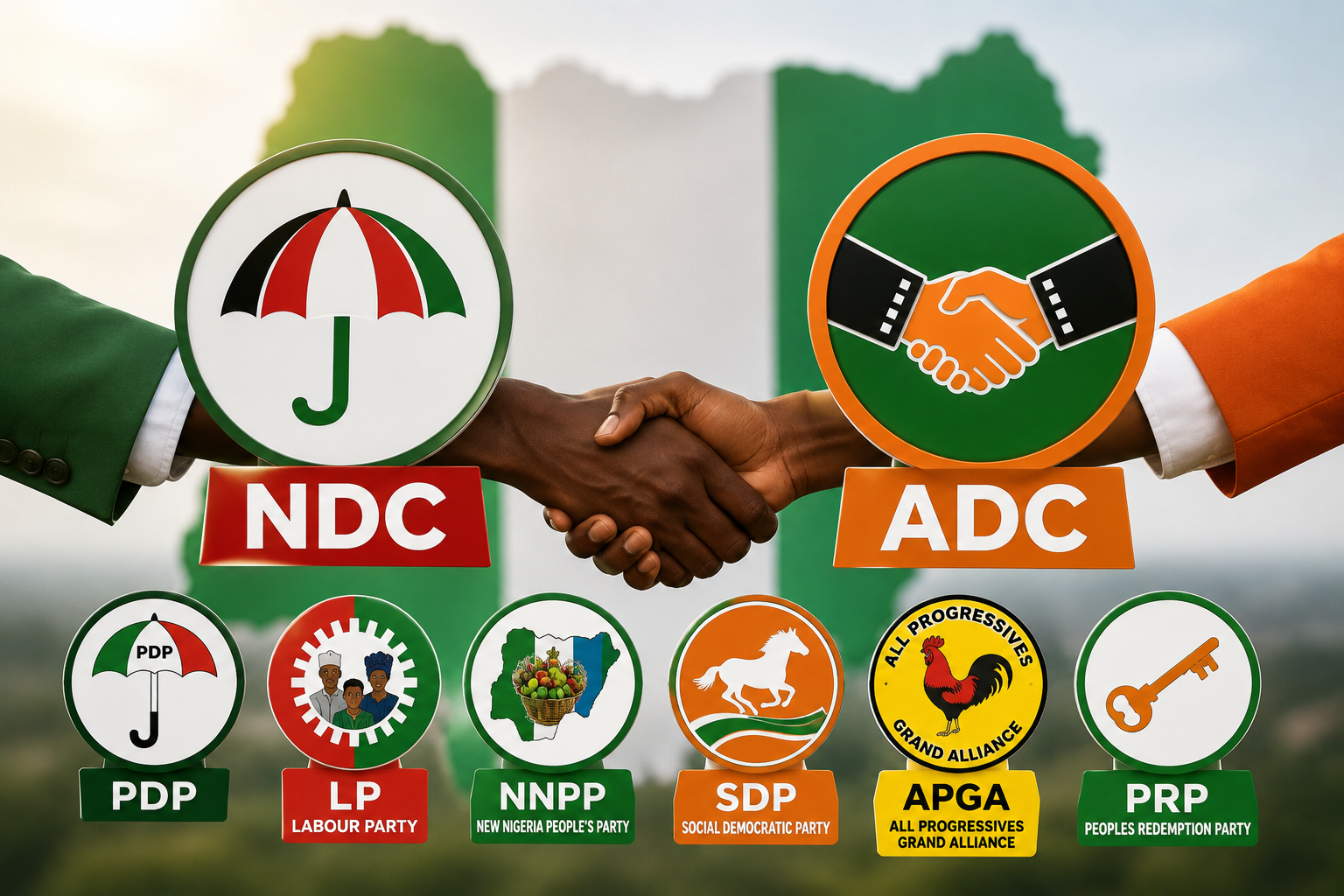
Rather than approaching future elections as separate political entities, opposition parties should negotiate a broad coalition founded on a common national agenda. Such a coalition must not be a mere electoral convenience but a carefully negotiated governance pact that clearly outlines leadership, policy direction and responsibility.
Power sharing should form part of that agreement. The presidency, vice presidency, principal offices in the National Assembly, cabinet appointments and strategic government positions should be distributed through transparent negotiations that reflect competence, inclusion and national balance. This would reduce post-election disputes and assure Nigerians that the coalition is prepared to govern from day one.
More importantly, the coalition must present a clear governance blueprint.
Nigeria needs an economic recovery programme that stimulates production rather than consumption. It needs policies that encourage industrialisation, support agriculture, strengthen small and medium-scale enterprises and restore investor confidence. Job creation must become the centrepiece of governance, particularly for millions of unemployed young Nigerians whose talents remain untapped.
Infrastructure development should move beyond political slogans. Roads, electricity, rail transport, healthcare, education, housing and digital connectivity require sustained investment and transparent execution. A nation cannot compete globally while its infrastructure continues to lag behind.
Security must also be approached with greater urgency and innovation. Beyond military operations, government must invest in intelligence gathering, policing reforms, technology, border security and community engagement while addressing the underlying socio-economic conditions that fuel crime and violence.
However, policy proposals alone will not be enough. Nigerians are increasingly demanding leaders whose credibility matches their promises. A coalition that merely changes faces without changing attitudes will offer little hope. Integrity, accountability and competence must become the defining principles of any alternative government.
This newspaper believes that a strong democracy requires both an effective government and an effective opposition. The absence of either weakens the nation.
The ruling party must continue to govern and be judged by its performance. Equally, the opposition must organise itself into a credible government-in-waiting capable of earning the confidence of Nigerians through ideas, discipline and preparedness.
Ultimately, the choice belongs to the Nigerian people. But they deserve genuine alternatives, not multiple parties pursuing identical ambitions from different platforms, but a united political movement capable of presenting a coherent national vision.
Nigeria’s challenges are too profound for an opposition divided by ego and self serving ambition. If those seeking power truly believe the country deserves better, they must first demonstrate the ability to work together. National interest must triumph over personal aspiration. The believe for a better Nigeria should drive a purposeful society in unity against the odds.
Only then can Nigerians be offered a credible choice, a competitive democracy and renewed hope for a nation whose immense potential has for too long remained unrealised. Nigerians are not zombies even the most foolish of us is wise enough to think of what’s good for all of us.
Paul Okojie is a Journalist and Media Consultant writing from Benin City.