

Edo’s N939.85bn Supplementary Budget: Growth, Gamble or Burden?
By Eben Enasco
In a swift legislative action, the Edo State House of Assembly on Monday October 19, 2026, approved a massive fiscal expansion for the state.
The 8th Assembly passed the 2026 Supplementary Budget of Nine Hundred and Thirty-Nine Billion, Eight Hundred and Fifty Million Naira.
The Bill, forwarded to the Assembly by Governor Monday Okpebholo last week, urgently scaled through after lawmakers considered and adopted the report of the House Standing Committee on Appropriation, Budget and Project Monitoring.
Presenting the report on the floor of the House, the Chairman of the Committee and member representing Esan Central, Hon. Fada Eigbiremonlen, laid out the recommendations that paved the way for its passage.
It was a major fiscal move in Edo State and analysts have described the supplementary budget as a significant fiscal expansion.
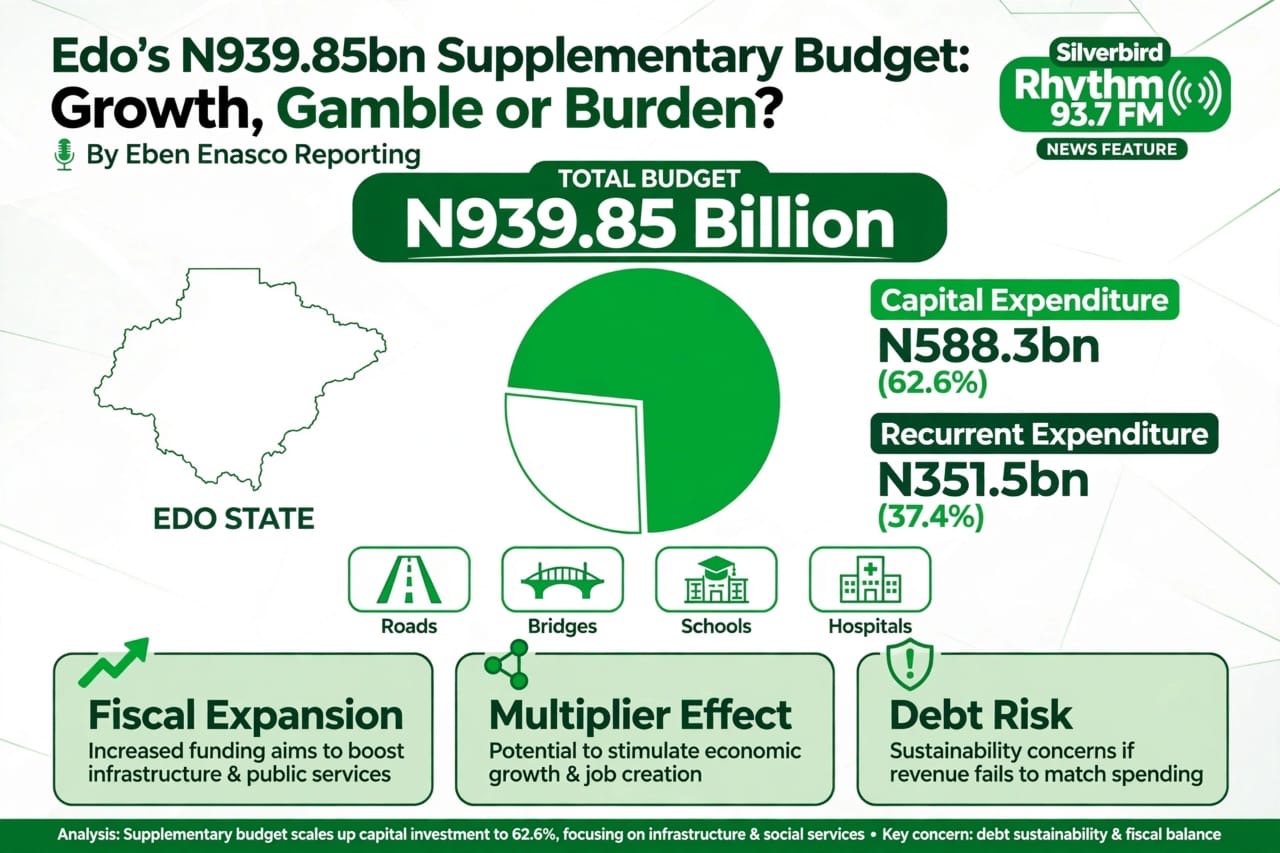
Under the Supplementary Appropriation Bill, capital expenditure will gulp Five Hundred and Eighty-Eight Billion, Three Hundred and Twenty-Four Million, Eight Hundred and Forty-Three Thousand, Eight Hundred and Four Naira, Sixty-Six Kobo, while recurrent expenditure will take Three Hundred and Fifty-One Billion, Five Hundred and Twenty-Five Million, One Hundred and Fifty-Six Thousand, One Hundred and Ninety-Five Naira, Thirty-Four Kobo.
In economic terms, this is a fiscal expansion that is capital-biased and growth-oriented, with a strong potential for multiplier effect and crowding-in of private investment.
But this sincerely, carries risks of fiscal deficit, debt overhang and inflationary pressure if not transparently implemented.
Looking at the summary; Capital Expenditure: N588.3 Billion 62.6% and the Recurrent Expenditure: N351.5 Billion 37.4%.
The Total Supplementary Budget is N939.85 Billion
With over 62 percent earmarked for capital projects, the move is expected to trigger a multiplier effect across the Edo economy.
POSITIVE IMPACTS TO THE PEOPLE:
Development-Driven: The fact that Capital 62.6% is higher than Recurrent 37.4% is a good sign.
It means more money is going to projects that touch people’s lives directly, roads, bridges, schools, hospitals, water, and not just salaries and overheads.
Job Creation: That huge capital vote of N588.3bn means more construction works, contracts for local suppliers, artisans, engineers, and daily paid labourers across Edo.When government builds, people work.
Infrastructure Push: This can help address the issues you have been raising, like the Ovia River Bridge, flood control in Benin, renovation of schools and markets like Oluku, and improving rural roads in Edo North, Central and South.
NEGATIVE / CONCERNS FOR THE PEOPLE:
Very Large Supplementary: N939.8 Billion as a supplementary budget alone is massive, almost as large as some states’ full annual budget.
It raises the question: Was the original 2026 budget not well planned, or are prices and priorities changing too fast?
Debt & Inflation Risk:
If this supplementary budget is to be funded by borrowing or extra loans, it could increase Edo State’s debt burden.
The people will eventually pay through reduced future spending.
Recurrent Still High: N351.5 Billion for recurrent in a supplementary budget is on the high side.
It suggests the government is also spending more on administration, political appointments, travels and running costs, not just projects. People want to see that money does not end up as salaries for new SAs and overheads.
Implementation Risk: In Nigeria, passing a budget is one thing, implementing it is another. Without transparency and civil society monitoring, capital projects may remain on paper.
ECONOMIC BENEFITS TO EDO PEOPLE:
Multiplier Effect: Every N1 billion spent on capital projects circulates at least 3-4 times in the local economy — from cement dealers in Sapele Road, to welders in Ekpoma, to food sellers at construction sites.
Attracts Investment: Good roads and infrastructure lower the cost of doing business. It will attract investors to Edo’s agro-processing, transport like New Edo Line revival and industrial hubs.
Improved Productivity: If part of this goes to health and education infrastructure, it builds human capital. Healthy, educated people produce more for the state economy.
Asset Creation: Unlike recurrent spending that disappears monthly, capital spending creates lasting assets, bridges, schools, hospitals that serve Edo people for 20-30 years.
BOTTOM LINE FOR ALL
This Supplementary Budget is pro-people on paper because it favours capital over recurrent.
But its real benefit to Edo people will depend on two things. First, what projects are in that N588.3bn and how transparently they are executed.
If it goes to real infrastructure, Edo wins. If it goes to political overheads, like election campaigns and abandoned projects, the people bear the cost.
Supplementary Appropriation Bill is seen by many as a second budget passed within the same year when the original budget is no longer enough due to rising costs, new projects, or revenue shortfall.
Capital Expenditure CAPEX – N588.3bn is Money spent to buy, build or fix long-term assets — roads, bridges, hospitals, schools.
This is Productive Spending.
Recurrent Expenditure – N351.5bn is Money spent on day-to-day running of government, salaries, allowances, fuel, office costs, SAs.
This is Consumptive Spending.
Capital-Recurrent Ratio 62:38: The balance between development and consumption. Economists call a ratio above 60% capital as
Development-Biased or Growth-
Oriented.
And for the Economic Impact, it is
when the government increases spending beyond the original budget to stimulate the economy.
This N939.8bn is a fiscal expansion.
Every N1 spent on construction creates N3-N4 in the economy because the bricklayer spends it at the market, the market woman spends it again. That’s why CAPEX is powerful as it stirs Multiplier Effect
When the government builds good roads and power, it crowds-in private business where investors now want to come to Edo because doing business becomes cheaper.
Human Capital Development: Spending on schools and hospitals not just physical bridges, but people. This is the foundation of long-term growth.
You are not just spending, you are creating wealth that lasts 30 years and that is Capital Formation or Asset Creation
If Edo does not have extra N939.8bn cash and has to borrow, it creates a deficit, i mean fiscal deficit and a negative side
Too much borrowing today reduces what future governments can spend the people pay tomorrow for today’s borrowing and that is Debt Overhang
Pumping almost a trillion naira extra into the economy at once can push up prices of cement, sand, labour in Benin, Ekpoma, Auchi, therefore causing Inflationary Pressure.
In Nigeria, we have High Appropriation, Low Cash-Backing
budget passed but not fully funded a system policy the Economist call
Budget Implementation Gap.
When recurrent keeps growing, economists call it Consumption Bias where the government is spending to maintain itself, not the people.
Every Naira spent on administration is a Naira not spent on Ovia Bridge, GRA deplorable roads, or the failed spot by Oluku Market. All eyes are now on implementation.