

When Politicians Say ‘Kill’: Osun and the Dangerous Road to 2027
Paul Okojie
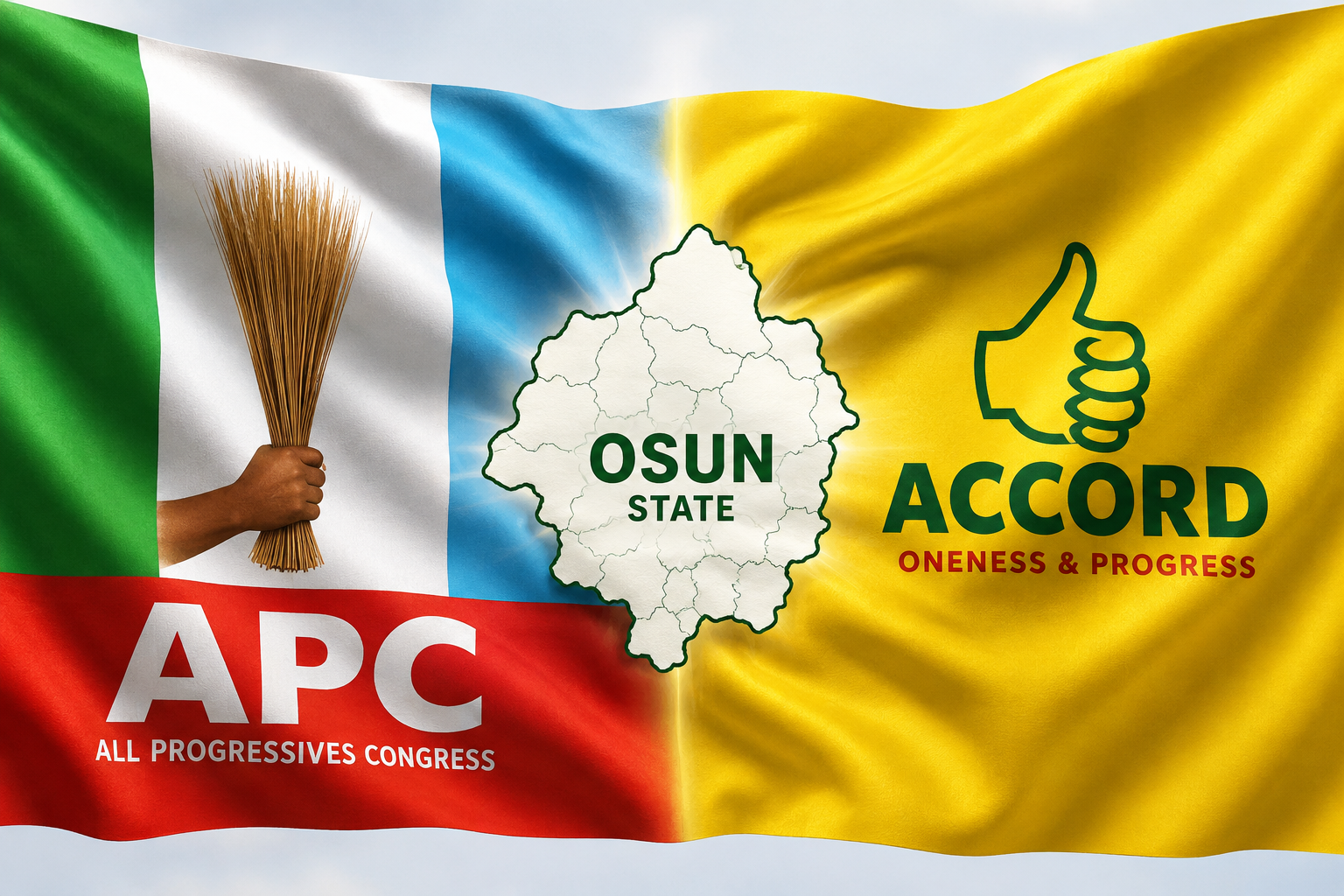
There are moments in a nation’s political journey when a single utterance ceases to belong to the individual who made it and instead becomes a mirror held up to the entire system. The controversy trailing Senator Francis Fadahunsi’s alleged instruction to supporters of the All Progressives Congress (APC) to “kill” members of the Accord Party ahead of the August 15, 2026 governorship election in Osun State is one such moment.
At first glance, it may appear like another episode in Nigeria’s familiar theatre of political excess another viral video, another denial, another clarification. But to treat it so lightly would be to miss the deeper and more troubling undercurrent: the increasing normalisation of violent language in the country’s political vocabulary, and the dangerous ease with which such language is now deployed in the heat of electoral contest.
A video circulating online reportedly shows the Osun East senator making remarks interpreted as a call to attack Accord Party members. The reaction was swift and predictable: outrage, condemnation, and a police invitation for questioning. The Commissioner of Police overseeing the Osun electoral environment reportedly summoned the senator to account for the statement, underscoring the sensitivity of the moment and the fragility of the political atmosphere already taking shape ahead of the 2026 governorship race.
In response, Senator Fadahunsi has offered clarification. Through his media office, he insisted that his use of the word “kill” was metaphorical, meant to signify electoral defeat rather than physical harm. He urged supporters to reject the Accord Party at the ballot box, not in the streets, and framed his comments as political rhetoric misunderstood in a volatile climate.
That explanation, while necessary, does not fully resolve the unease the incident has generated.
For in politics, meaning is not only what is intended; it is also what is heard, repeated, and acted upon. In a country where political violence has too often moved from rhetoric to reality, the distinction between metaphor and instruction can become dangerously thin. Leaders, especially elected lawmakers, do not speak into a vacuum. They speak into communities already primed by tension, rivalry, and, in some cases, a history of electoral bloodshed.
This is why the Osun episode cannot be dismissed as a mere semantic misunderstanding. It is instead a reminder of how fragile the boundary between political expression and incitement has become.
Even before this controversy, Osun State was already navigating a politically charged environment. Security agencies had issued repeated warnings to political actors to avoid violence, while rival parties traded accusations of intimidation and attacks. The Inspector-General of Police had publicly cautioned that the state would not tolerate any attempt to disrupt the electoral process. Against this backdrop, every word uttered by political leaders carries amplified weight.
A senator, by virtue of office, is not an ordinary campaigner. His words do not dissolve into the crowd; they echo through it.
This is where the danger lies. When political leaders resort to language that can be interpreted as sanctioning violence, even metaphorically, they risk handing over their authority to the most volatile elements of their support base. In such moments, nuance is often lost in translation, and what remains is the raw emotional charge of the statement itself.
Nigeria has seen this pattern before. History offers too many examples of elections where rhetoric hardened into hostility, and hostility into violence. The lesson should by now be unmistakable: words matter, and in a tense political environment, they matter even more.
The clarification that “kill Accord” meant “defeat them with votes” is, in fact, the kind of language that should have been used in the first place. Democracy does not require metaphors of destruction to express political competition. It already possesses its own vocabulary of contest, choice, and rejection. To defeat an opponent at the ballot box is not a euphemism; it is the essence of democratic practice.
The tragedy is that such clarity is often abandoned in favour of more aggressive, attention-grabbing rhetoric that may energise supporters in the short term but corrodes the political atmosphere in the long run.
Osun as a Warning, Not an Exception
What makes the Osun controversy particularly significant is not its uniqueness, but its familiarity. It reflects a broader national pattern in which political competition is increasingly framed in existential terms—us versus them, victory versus annihilation, survival versus elimination.
As Nigeria edges closer to the 2027 general elections, this pattern should concern anyone invested in the country’s democratic stability. The stakes of national elections are always high, but when political language begins to mirror the language of conflict, the stakes become dangerously distorted.
Elections are not wars. Opponents are not enemies of the state. And political disagreement is not a licence for hostility. Nigerians have died for this Democracy, will Nigerians continue to die to elect leaders in the same Democracy.
Yet, across the political spectrum, there is a growing tendency to blur these distinctions. Words like “crush,” “destroy,” and “wipe out” have become commonplace in campaign discourse. While often dismissed as mere figures of speech, they contribute to an atmosphere in which political competition is stripped of civility and increasingly framed as a zero-sum struggle.
This is precisely the environment in which violence finds fertile ground. The Responsibility of Power The police invitation extended to Senator Fadahunsi is therefore more than a procedural response; it is a test of institutional seriousness. It signals that public office does not place anyone above scrutiny when their words risk inflaming tensions.
Civil society organisations, including Amnesty International, have also weighed in, describing the remarks as reckless and calling for accountability. Their concern is not misplaced. In fragile political environments, accountability is not about punishment alone; it is about deterrence and the reinforcement of norms.
But enforcement must be even-handed. The credibility of Nigeria’s security and electoral institutions depends on their ability to apply standards consistently, without regard to party affiliation or political status. Selective accountability would only deepen mistrust and further erode public confidence.
The Road to 2027
The Osun incident should be read as an early warning signal rather than an isolated controversy. It offers a glimpse into the kind of political climate that could define the 2027 elections if current trends continue unchecked. Nigerians are in serious trouble and they have to make a choice either to end these kind of politics and politicians.
Nigeria does not lack electoral experience. What it often lacks is restraint. Political parties must begin to take greater responsibility for the language used by their members. Leaders must recognise that discipline is not a sign of weakness but of maturity. And public office holders must understand that their words are not private expressions but public instruments with real-world consequences.
A senator is not just a participant in political debate; he is a shaper of it. A governor is not merely a party figure; he is a symbol of authority. A presidential candidate is not simply a contender; he is a national signal.
When such figures speak, they do not merely communicate—they set tone, direction, and sometimes, unintended permission.
Choosing a Different Political Future: At its core, the lesson from Osun is simple but urgent, democracy cannot thrive where political opponents are treated as enemies to be eliminated rather than citizens to be persuaded.
If Senator Fadahunsi’s intent was truly to advocate electoral defeat rather than physical harm, then the language of politics must reflect that clarity. There is no shortage of words in a democratic system to express competition without invoking violence.
To “kill” an opponent with votes is, in fact, to affirm democracy. To defeat ideas with better ideas is to strengthen it. To remove leaders through ballots is to preserve its legitimacy.
Anything beyond that risks dragging the political system into a darker register—one where rhetoric and reality begin to blur in dangerous ways.
As Nigeria moves toward 2027, the question is not only what politicians say, but what kind of political culture their words are shaping.
Do they prepare citizens for peaceful competition or for confrontation? Do they reinforce trust in the ballot or suspicion of the process? Do they elevate democracy or erode it?
These are not abstract concerns. They are the foundations upon which the credibility of the next election will rest.
The Osun controversy, therefore, should not fade quietly into the archive of political scandals. It should stand as a reminder that democracy is sustained not only by institutions and laws, but by language carefully chosen, responsibly used, and consciously restrained.
For in the end, the strength of any democracy is measured not by how loudly its politicians speak, but by how safely its citizens can listen.
Paul Okojie is a Media Consultant/Journalist writing from Benin City.