

AI and Human Intelligence: The New Tower of Babel and the Future of Humanity
Artificial Intelligence (AI) has emerged as one of the most transformative technologies of the 21st century. From healthcare and education to finance, security, media, and governance, AI is rapidly reshaping human civilization. While many celebrate its potential to solve complex problems and improve quality of life, others warn of the profound risks it poses to humanity, ethics, employment, and even human identity itself.
Among the most notable voices expressing concern is Pope Leo XIV, who has repeatedly cautioned against the unchecked development of artificial intelligence. Echoing concerns previously raised by Pope Francis, the Pope has described the growing power of AI as resembling a “new Tower of Babel”—a powerful biblical metaphor with deep implications for modern society.
The Tower of Babel Analogy
According to the Book of Genesis, humanity once sought to build a tower reaching the heavens. Driven by ambition and technological prowess, people attempted to elevate themselves to a divine status. The project ultimately resulted in confusion, division, and the fragmentation of human communication.
By comparing AI to a new Tower of Babel, the Pope highlights a growing concern that humanity may once again be pursuing technological advancement without sufficient ethical wisdom. The warning is not necessarily against innovation itself, but against a future where technology outpaces human values, accountability, and moral responsibility.
The central question is no longer whether AI can perform tasks once reserved for humans. It is whether society can ensure that technological power remains subordinate to human dignity and collective well-being.
AI Versus Human Intelligence
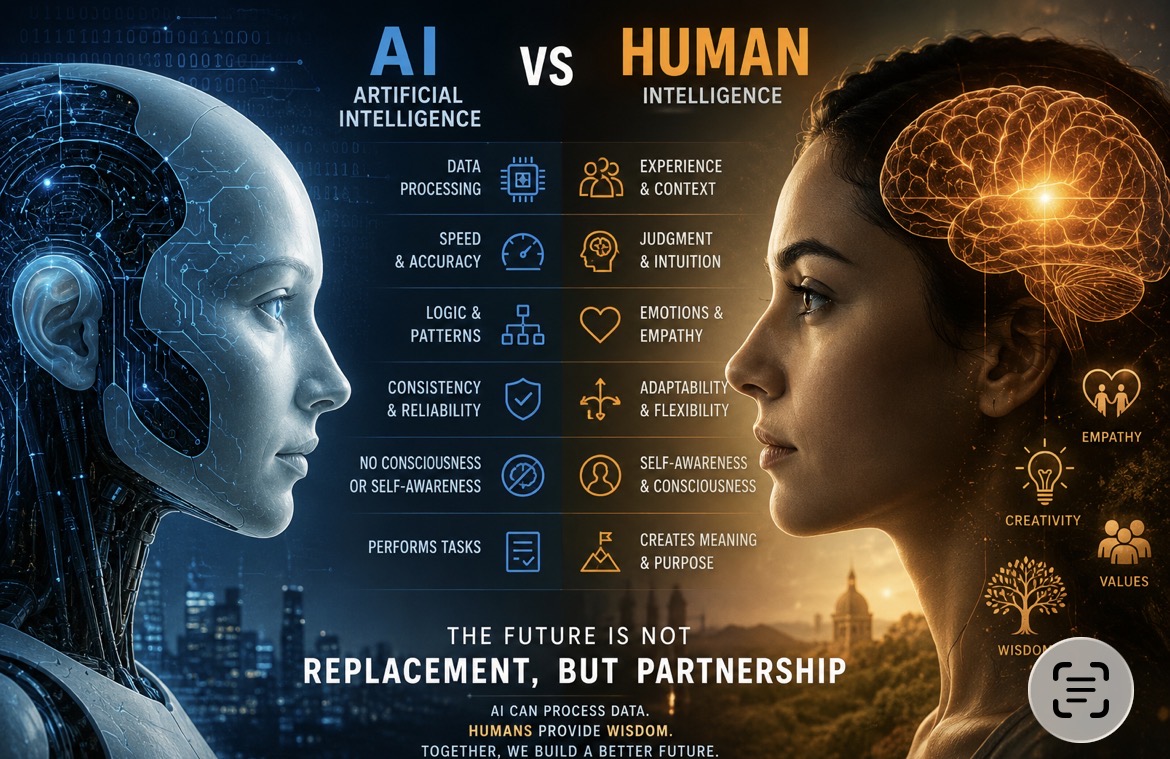
Artificial Intelligence and human intelligence differ fundamentally.
Human intelligence is shaped by consciousness, emotions, empathy, morality, intuition, cultural experiences, and personal relationships. Human beings possess the ability to exercise judgment in complex ethical situations and understand the emotional consequences of their actions.
AI, by contrast, operates through algorithms, data analysis, and pattern recognition. It can process vast amounts of information at extraordinary speed and often outperform humans in specific tasks such as data analysis, language processing, image recognition, and strategic gaming.
However, AI does not possess consciousness, self-awareness, compassion, or moral understanding. It can simulate human conversation and decision-making but lacks genuine understanding of human suffering, love, sacrifice, or justice.
This distinction is increasingly important as governments, corporations, and institutions rely on AI to make decisions affecting millions of people.
The Promise of Artificial Intelligence
The benefits of AI are undeniable.
In healthcare, AI assists doctors in diagnosing diseases earlier and more accurately. In agriculture, it helps farmers predict weather patterns, monitor crops, and improve yields. In education, personalized learning systems can support students according to their individual needs.
AI is also revolutionizing transportation, scientific research, disaster prediction, cybersecurity, and public administration. Economists estimate that AI could contribute trillions of dollars to global economic growth over the coming decades.
For developing nations such as Nigeria, AI presents opportunities to improve governance, expand digital services, strengthen security systems, modernize agriculture, and enhance educational access.
The Risks to Human Society
Despite its advantages, AI presents significant challenges.
One of the most immediate concerns is job displacement. Automation threatens millions of traditional jobs across sectors including manufacturing, transportation, customer service, banking, media, and administration. While new jobs may emerge, many workers risk being left behind without adequate retraining.
Another concern is misinformation. AI-generated content can create convincing fake images, videos, speeches, and news reports capable of manipulating public opinion and undermining trust in democratic institutions.
Privacy is also under threat. AI systems rely heavily on data collection, raising questions about surveillance, personal freedoms, and the misuse of sensitive information.
Even more concerning is the possibility that powerful AI systems could be controlled by a small number of governments or technology corporations, creating unprecedented concentrations of economic and political power.
The Ethical Challenge
The Pope’s warning ultimately points to an ethical challenge rather than a technological one.
Humanity has always developed powerful tools—from fire and the printing press to electricity and nuclear energy. The critical issue has never been the tool itself but how it is used.
AI can become a force for liberation or domination, prosperity or inequality, truth or manipulation. Its future depends on the values guiding its development.
Religious leaders, philosophers, scientists, policymakers, and civil society organizations increasingly argue that AI must be governed by principles that prioritize human dignity, transparency, accountability, fairness, and justice.
Without ethical safeguards, society risks creating technologies that serve efficiency while neglecting humanity.
A Future of Partnership, Not Replacement
The most sustainable vision for the future may not be one where artificial intelligence replaces human intelligence, but where it complements it.
Machines can process data, but humans provide wisdom.
Machines can calculate probabilities, but humans make moral choices.
Machines can automate tasks, but humans create meaning.
The challenge facing the world is to ensure that AI remains a tool that enhances human potential rather than diminishes it. As the Pope’s Tower of Babel analogy suggests, technological advancement without ethical direction can lead to division and confusion. Yet with responsible leadership and shared values, AI can become one of humanity’s greatest achievements.
The future will not be determined solely by the intelligence of machines, but by the wisdom of the people who create and control them.