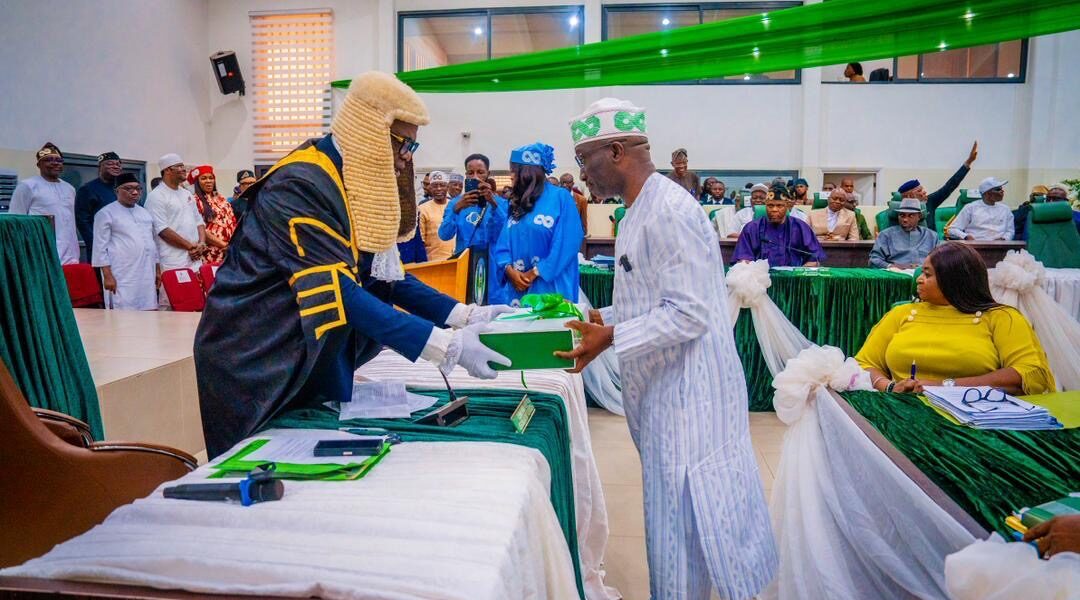

Edo State Governor, Senator Monday Okpebholo, on Tuesday presented a ₦939.85 billion 2026 Appropriation Bill, tagged the “Budget of Hope and Growth,” to the Edo State House of Assembly.
The budget was presented at a plenary session presided over by the Speaker, Rt. Hon. Blessing Agbebaku.
Addressing lawmakers, Governor Okpebholo commended the Assembly for its cooperation, which he said ensured the successful implementation of the 2025 budget and delivered measurable benefits to residents of the state.
According to the governor, the strong performance of the 2025 budget, improved Internally Generated Revenue (IGR), and gains recorded from blocking revenue leakages informed the priorities of the 2026 fiscal plan.
On security, Okpebholo said his administration had taken decisive steps to curb cultism, kidnapping, robbery and cybercrime, recalling that more than 300 cult-related killings were recorded in the state in 2024 before he assumed office. He said a strengthened anti-cultism law, the provision of 80 Hilux patrol vehicles and 400 motorcycles, and the recruitment and training of 2,500 officers into the Edo State Security Corps had significantly improved security across the state.
In the health sector, the governor said his administration was rebuilding a previously weakened system through the construction of new Primary Health Centres, provision of diagnostic equipment, and the ongoing construction of a 150-bed Specialist Hospital in Edo Central Senatorial District.
On infrastructure development, Okpebholo disclosed that 28 new road projects covering about 255 kilometres had been awarded, including two flyover projects in Benin City at Ramat Park and Sapele Road by Adesuwa Junction. He said the flyovers would be the first in the history of Edo State, while several community roads were also under construction to improve connectivity.
The governor said agriculture received a major boost in the proposed budget, with sectoral allocation increased from ₦6.9 billion to ₦57 billion. He added that more than 400 hectares of farmland had been cultivated, with harvesting already ongoing across farm clusters to address food insecurity.
In education, Okpebholo said his administration recruited 5,000 permanent teachers and upgraded 63 schools, with more undergoing rehabilitation. He also announced increased subventions to tertiary institutions, raising Ambrose Alli University’s monthly allocation from ₦41 million to ₦500 million and Edo State University, Iyamoh, from ₦25 million to ₦250 million.
On economic growth, the governor said the state inherited significant foreign and domestic debts but had begun a gradual reduction process. He disclosed that over 10,000 direct and indirect jobs had been created, alongside the introduction of a ₦1 billion interest-free loan scheme for traders and market women.
He also highlighted governance reforms, including the swearing-in of three judges, the re-establishment of customary courts, and the strengthening of traditional institutions to improve trust and cooperation across governance levels.
The 2026 budget proposes ₦637 billion (68 per cent) for capital expenditure and ₦302 billion (32 per cent) for recurrent expenditure. Funding sources include projected IGR of ₦160 billion, FAAC allocations of ₦480 billion, capital receipts and grants of ₦153 billion, Public-Private Partnerships valued at ₦146 billion, and other revenue streams.
Sectoral allocations show ₦614.2 billion for the economic sector, ₦148.9 billion for the social sector, ₦157.7 billion for the administration sector, and ₦19 billion for the justice sector, with additional provisions for regional development and support to local government councils.
Governor Okpebholo said the budget is anchored on his administration’s SHINE Agenda—Security, Health, Infrastructure, Natural Resources/Agriculture and Education—and is aimed at delivering inclusive, people-centred development.
The plenary was attended by the Deputy Governor, Rt. Hon. Dennis Idahosa; the Secretary to the State Government, Umar Musa Ikhilor, Esq.; former deputy governors; members of the State Executive Council; traditional rulers; civil society representatives and members of the press.
The governor formally presented the 2026 Appropriation Bill to the House for legislative consideration and approval.